Halloween’s familiar orange glow has a history that reaches far beyond candy aisles. Here’s how a seasonal turning point became a celebration of costumes, lanterns, television, and neighborhood traditions.
A holiday made from more than one tradition
Halloween is not the invention of a single village, one church, or one candy company. Its long story pulls together Gaelic seasonal observances, Christian feast days, European folk customs, and North American neighborhood celebrations. The result is a familiar October 31 that would look very different to people living even a century ago. Tracking the changes is more interesting than pretending every modern tradition has an unbroken ancient origin.
Before Halloween: Samhain and the turn toward winter
In Ireland, Samhain traditionally marked the start of winter on November 1, with most festivities taking place the preceding evening. The end of harvest and arrival of darker days made this a distinctive turning point in the year. Irish folk collections describe feasting, fruit-and-nut games, visiting in disguise, divination, and beliefs about returning spirits. Records of specific rituals differ by place and era; we should resist treating any one popular modern description as a perfect snapshot of ancient Celtic religion.

Why we call it Halloween
All Saints’ Day, observed on November 1 in Western Christianity, gave October 31 its English name: All Hallows’ Eve. All Souls’ Day on November 2 also encouraged customs of remembering the dead. Historians have long debated the exact relationship between these observances and earlier Samhain traditions. What is clear is that overlapping calendar dates and centuries of religious and folk practice helped give the late-October season its distinctive mixture of remembrance, celebration, and supernatural storytelling.
Masks, visiting, and the road to trick-or-treating
Costume visiting is older than supermarket candy bags. In parts of Ireland and Scotland, guisers wore disguises, visited neighbors, and might perform songs or jokes in exchange for small gifts. Some Christian customs involved souling—seeking food in exchange for prayers. These practices are related to, but not identical with, today’s trick-or-treating. As migrants carried festive customs across the Atlantic, the American Halloween celebration gradually became more neighborhood-centered, especially in the twentieth century.

How turnips became glowing pumpkins
Carved lantern traditions in Ireland used root vegetables such as turnips. A folk tale about Stingy Jack later became associated with the eerie lantern. In North America, large pumpkins were plentiful and easier to carve, making them a natural replacement. By the late nineteenth and early twentieth centuries, photographs, postcards, newspaper illustrations, and advertisements repeatedly featured the glowing pumpkin face that would become the holiday’s most recognizable emblem.
The Halloween party moves into American homes
By the turn of the twentieth century, American magazines and postcards commonly presented Halloween as an occasion for parties. There were games involving apples and nuts, fortune-telling amusements, paper decorations, costumes, and elaborate invitations. Halloween was playful and sometimes mischievous as well as scary. The vintage orange-and-black postcards we collect today came from that social world, decades before horror movies became a central part of the season.

From mischief night to candy routes
In the twentieth century, civic parties and organized neighborhood activities helped redirect some Halloween pranking into community celebrations. Trick-or-treating grew increasingly familiar in American suburbs after World War II. Wrapped candy, rising suburban populations, and mass-marketed costumes made the ritual easy to repeat from street to street. The doorbell, the costume, and the bucket of sweets became part of a shared cultural script.
When Halloween arrived on television
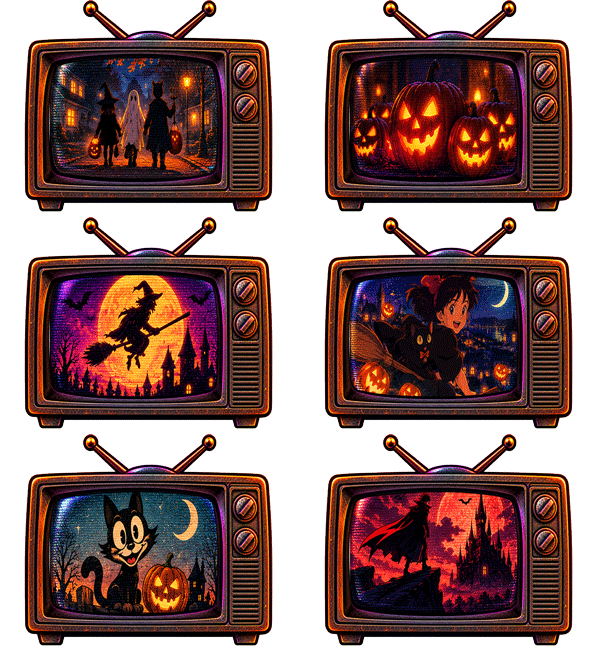
Television helped turn a once-local celebration into a season of familiar media rituals. Holiday-themed episodes, cartoons, costume contests, spooky commercials, and seasonal movie marathons became fixtures in many households. Later, home video, cable television, browser games, and streaming added new ways to revisit October favorites. That is the modern layer of Halloween history this website collects: not just how the holiday began, but how it became something people watch, play, and remember.

An October tradition that keeps changing
Today Halloween means very different things to different people: an evening of trick-or-treating, a night at a haunted attraction, a family craft session, a horror-film marathon, or simply a love of autumn imagery. The holiday has survived precisely because it is flexible. Every generation preserves a little of the old tradition, adds something new, and leaves the next generation its own version of October.
References & further reading
- National Museum of Ireland — Halloween / Samhain traditions ↗
- Library of Congress — The Origins of Halloween Traditions ↗
- Smithsonian Magazine — The Celtic Origins of Trick-or-Treating ↗
- NASA Earth Observatory — Halloween History ↗
Research note: interpretations of ancient practices vary. This article distinguishes documented later folklore from claims about antiquity.